How AI Is Reshaping Your Competitive Landscape
How to assess your competitive position when the rules are being rewritten.
Artificial intelligence isn’t just another technology trend - it’s a structural shift reshaping industries, business models, and entire markets. But with so much noise, hype, and rapid change, it can be hard for leaders to understand what AI actually means for their competitive position.
During my MBA studies, it sometimes felt like everything had a model or framework - a framework tying your shoes, a model for deciding on dinner- and while many of them felt a bit overcooked, one that genuinely stood out for its clarity was Porter’s Five Forces. It offered something rare: a simple, elegant way to understand the pressures shaping a business - and at Binary Refinery, elegance in simplicity is something we deeply value.
Applied to AI, this classic framework becomes even more powerful. It helps leaders move past the jargon and ask:
Where are the pressures on our business coming from?
Where do we have real strategic control?
Where should we place bets - and where should we strengthen defences?
Here’s how the Five Forces shift in an AI-driven world - and what that means for the future of your organisation.
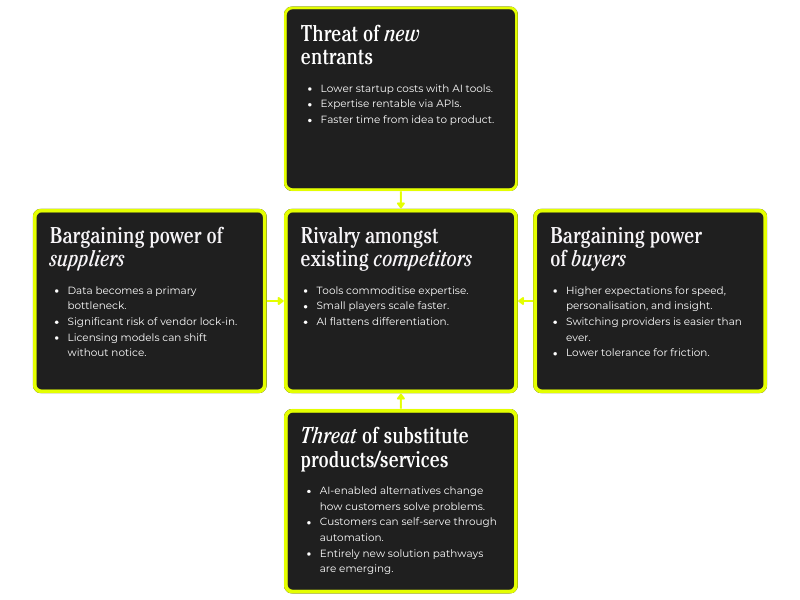
1. Competitive Rivalry: AI is flattening the field
AI reduces many traditional sources of differentiation. Tasks that once required specialist staff, large teams, or deep institutional knowledge can now be automated or augmented at low cost.
What this means for businesses
Competitors can leapfrog each other faster than ever.
Small players can look big; big players can move faster than they used to.
Unique capabilities can become commodities almost overnight.
Where to focus
Differentiate through process, customer experience, and governance, not just tools.
Build internal AI capability, not just AI output.
Use AI to deepen, not dilute, what makes your business valuable.
2. Threat of New Entrants: AI lowers the barriers
With AI, startup costs drop. Expertise can be rented via APIs. Automation replaces early hires. Insights can be generated without full teams.
A company can go from idea to minimum viable operation in days, not months.
What this means
Expect more competition, entering faster, with fewer constraints.
Professional services, in particular, are now much easier to replicate.
Where to focus
Strengthen brand trust and reputation — these cannot be automated.
Build human-centred value your competitors can’t copy.
Implement AI strategically to increase responsiveness and reduce cost, so new entrants don’t undercut you.
3. Threat of Substitutes: AI is creating entirely new ways to solve old problems
AI doesn’t just optimise existing solutions - it replaces them.
Marketing agencies compete with AI content engines. Consultants compete with automated research. Customer service teams compete with conversational agents. Analysts compete with autonomous insights.
What this means
Your customers may start solving their problems in entirely different ways.
Substitutes may come from outside your industry.
Where to focus
Redefine your value proposition: What do you provide beyond the task?
Create AI-enabled products and services that complement your expertise.
Move from deliverables to outcomes. From outputs to intelligence.
4. Bargaining Power of Suppliers: Data is the new supply chain
In AI, your “suppliers” aren’t just vendors - they are:
Model providers (OpenAI, Anthropic, Google, etc.)
Data sources
Infrastructure partners
Integrations and platforms
How AI changes this force
A small number of model providers hold enormous influence.
Licensing can change overnight.
Data quality dictates AI performance - garbage in, garbage out.
Switching costs can be high if you rely heavily on proprietary ecosystems.
Where to focus
Avoid vendor lock-in by using platform-agnostic architectures.
Build structured, clean, governed data to reduce dependency risk.
Develop AI governance to manage model, data, and risk lifecycles.
5. Bargaining Power of Customers: Expectations have expanded
AI has trained customers - both business and consumer - to expect:
Instant answers
Personalisation
24/7 availability
Lower costs
Better quality
If you can’t deliver this baseline, your competitors will.
What this means
Customers now have more choice than ever.
Switching is easier.
Loyalty is fragile.
Where to focus
Use AI to elevate service and response times, not just cut costs.
Build transparent, ethical AI use policies to increase trust.
Engage customers with AI-powered insights and better decision-support.
So… what’s the strategic takeaway?
AI doesn’t remove competitive pressures - it intensifies them.
It collapses barriers, accelerates imitation, empowers customers, and reshapes industries.
But businesses that respond strategically - not reactively - can use AI to strengthen their competitive position rather than erode it.
The question isn’t “Should we use AI?”
It’s “Where will AI reshape our strategy - and how do we stay ahead of those forces?”
How Binary Refinery can help
We work with organisations across New Zealand to:
Assess how AI reshapes their competitive landscape.
Build AI strategies aligned to business priorities.
Develop responsible AI governance frameworks.
Upskill teams and leadership so AI becomes a capability - not a chaos-maker.
If you’d like support applying these forces to your own organisation, we can take you through a structured AI Readiness & Competitive Positioning Assessment.

About the Author
Kat Mac is the founder of Binary Refinery, where she translates complex AI and technology topics into practical, business-led guidance for organisations. Her focus is simple: clarity, integrity, and strategy that genuinely helps leaders move forward.
Disclaimer: This article is for general information only. It isn’t legal, financial, or technical advice. Every organisation is different – get tailored guidance before making decisions that affect your people, data, or systems.